May 9 – May 16
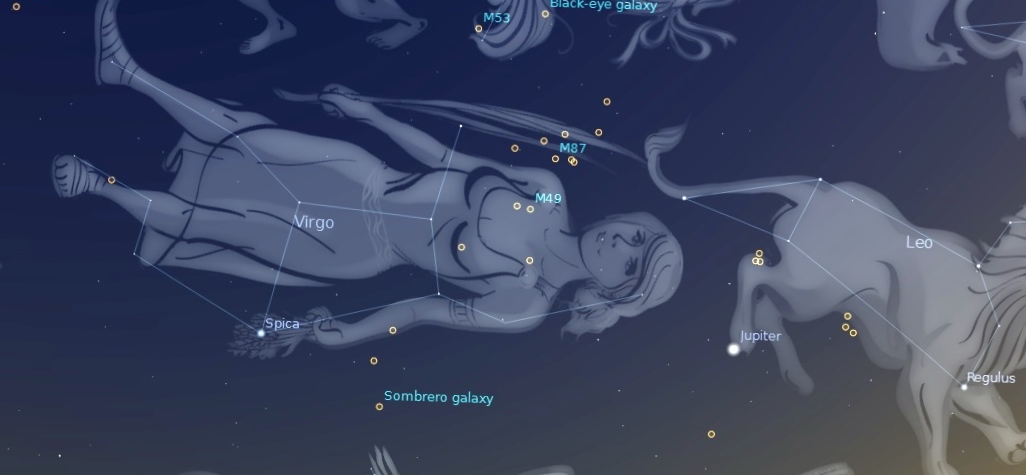
With Mother’s Day occurring this weekend, here is a tale of a mother who went through hell to recover her abducted daughter. The constellation Virgo represents Demeter, the Greek goddess of agriculture and a daughter of the Cronus and his sister-wife Rhea. She was responsible for providing conditions for the planting, growth and harvest of crops so that people could eat. Demeter had a daughter, Persephone, who was abducted by Hades to reign by his side in the Underworld. The despondent mother neglected her duties to search and mourn for her daughter, which resulted in crop failure and famine. Olympian king Zeus heeded the pleas of his starving people and allowed Demeter to visit the Underworld and return with their daughter. The crops were rejuvenated. To appease Hades, Persephone was to be with her mother for only the six months of the growing season each year, and for those six months we see Virgo in our evening sky.
Virgo is midway up the southern sky in late evening this week, marked by the bright star Spica which represents a sheaf of wheat or an ear of corn. This area of the sky is popular among amateur astronomers due to the many distant galaxies that are within reach of backyard telescopes. Virgo was also seen as Astraea, the goddess of justice and purity who holds the scales of Libra the Balance in her hand. The constellation Libra follows Virgo along the ecliptic.
This Week in the Solar System
Saturday’s sunrise in Fredericton is at 6:02 and sunset will occur at 8:44, giving 14 hours, 42 minutes of daylight. Next Saturday the Sun will rise at 5:53 and set at 8:53, giving 15 hours of daylight.
The Moon is at third quarter this Saturday and new next Saturday. Early risers might catch the waning crescent chumming with Saturn and perhaps Mars mid-to-late week. After twilight bright Venus and Jupiter form a broad parallelogram with first magnitude stars Procyon and Capella, stretching from west to northwest. On Friday, May 15, telescope users might see Jupiter’s moon Ganymede emerge from a transit at 10:02 pm, Callisto disappear into Jupiter’s shadow at 10:09, and Europa’s shadow appear on the planet five minutes later. Mercury is at superior conjunction behind the Sun on Thursday, soon to reappear in the evening sky.
Tune in to the Sunday Night Astronomy Show at 8 pm on the YouTube channel and Facebook page of Astronomy by the Bay. The Fredericton Astronomy Club meets in the UNB Forestry-Earth Sciences building on Tuesday at 7 pm. The Kouchiboguac Spring Star Fest is on for May 15-16. For details see: https://rascnb.ca/star-parties/
Questions? Contact Curt Nason at [email protected].
May 2 – May 9
In the second century BCE the Greek astronomer Hipparchus of Nicaea ranked the stars according to their brightness in six categories called magnitudes (for greatness). The 20 brightest stars were rated first magnitude and the faintest stars were sixth magnitude. This system was retained for two millennia and standardized in the 19th century when much fainter stars were being detected by telescopes and astrophotography. English astronomer Norman Pogson devised a logarithmic system whereby five magnitudes was a difference in star brightness of exactly 100 times. With this system, a magnitude 1 star is about 2.5 times brighter than a magnitude 2 star, and that one is 2.5 times brighter than a star of magnitude 3.
For many of us, the faintest star we can detect with the naked eye in a dark sky is sixth magnitude (commonly called mag 6). Vega, the fifth brightest star, is mag 0, slightly dimmer than Arcturus and slightly brighter than Capella. With the ability to measure the exact brightness of stars, their magnitudes are often recorded to one or two decimal places, and negative values are used for very bright objects. Sirius is mag -1.4, Jupiter is usually around mag -2.4 and Venus around -4.5. The full Moon is mag -12.6, approximately 400,000 times fainter than the Sun at -26.7. A first magnitude star, of which there are 22, is brighter than mag 1.50; a second magnitude star shines from mag 1.50 to 2.49, and so on.
This Week in the Solar System
Saturday’s sunrise in Moncton is at 6:04 and sunset will occur at 8:28, giving 14 hours, 24 minutes of daylight (6:11 and 8:31 in Saint John). Next Saturday the Sun will rise at 5:54 and set at 8:37, giving 14 hours, 43 minutes of daylight (6:01 and 8:40 in Saint John).
The Moon is near Antares on Sunday morning and it is at third quarter next Saturday. Venus sets around 11 pm this weekend, followed by Jupiter a few hours later. On Friday evening, May 8, telescope users might see a double shadow transit of Jupiter’s moons Ganymede and Europa between 9:45 and 10:26. This weekend Saturn rises an hour before sunrise followed by Mars ten minutes later. Mercury is lost in morning twilight, moving into the evening sky later this month. Early risers might see a few shooting stars from the Eta Aquariid meteor shower on Wednesday.
The Saint John Astronomy Club meets in the Rockwood Park Interpretation Centre this Saturday at 7 pm. Tune in to the Sunday Night Astronomy Show at 8 pm on the YouTube channel and Facebook page of Astronomy by the Bay.
Questions? Contact Curt Nason at [email protected].